
Custom Hanging Mobile Sculpture and Mies van der Rohe Daybed
A custom designed mobile I made in 2012 with the modern classic Mies van der Rohe daybed (to illustrate the size of the mobile). It measures 5.5 feet in height and 4.5 feet width, made with steel (sheet metal, wire, rivets) and a solid lead metal weight:
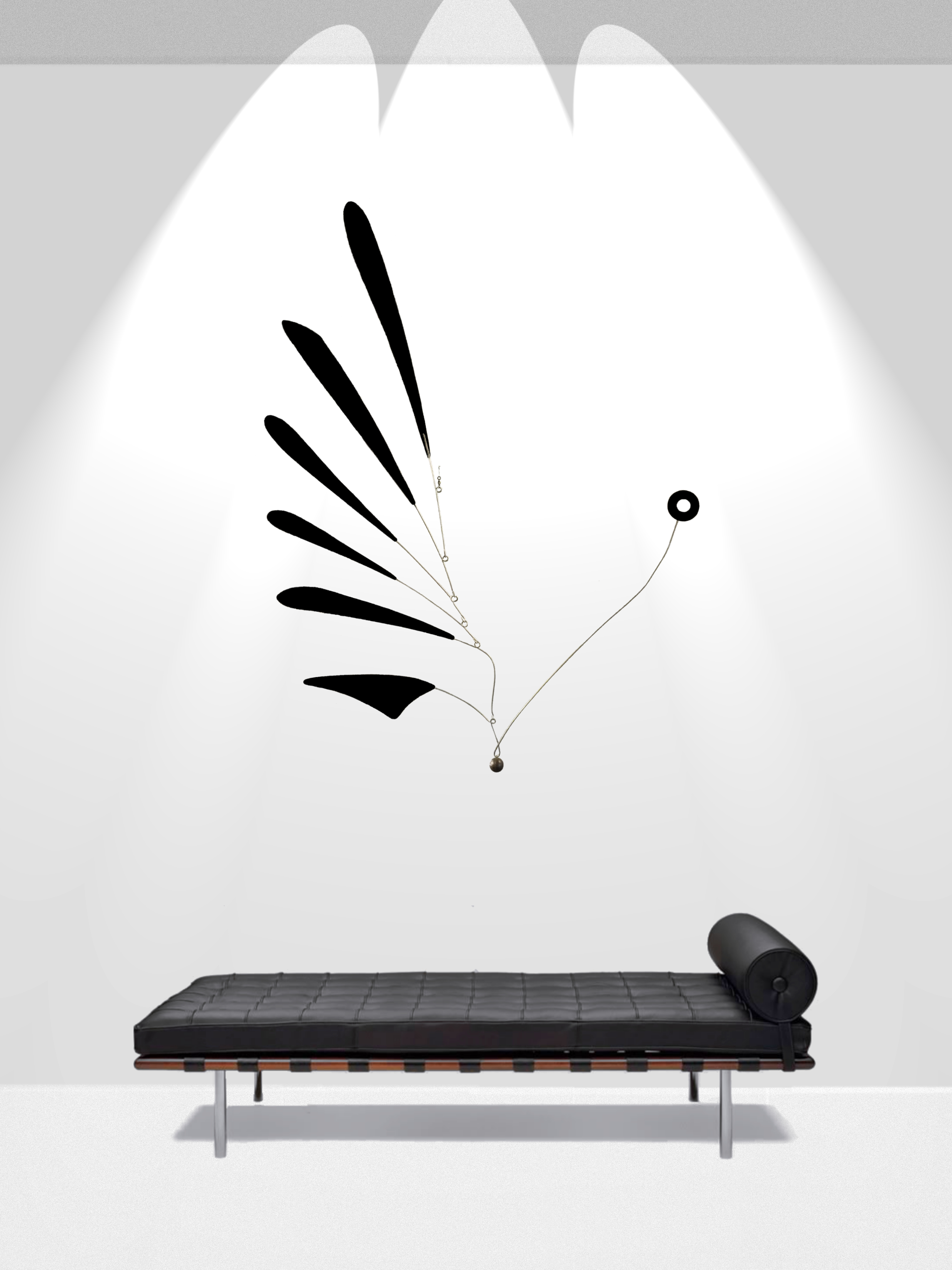
This mobile became the original inspiration for the custom-made mobile I made for the movie The Upside released in 2019.
It seems to me that this mobile crosses over from a mid-century modern style to a more contemporary one, in one of my earlier ventures to break away from Alexander Calder‘s work and to expand the art form of mobiles that he created beyond his work, which eventually led to these contemporary mobile sculptures, this hypothesis and these much more complex and intricate mobile sculptures.
The mobile shown here moves beautifully with the air currents. Although originally not intended for outdoors, I suspended it in the yard for a while, and it proved strong enough to withstand an intense storm. The weight at the bottom provides for quite a bit of stability. It’s a kinetic mobile sculpture, but it would make for a sophisticated hanging wall sculpture as well. I still have a stack of drawings with mobiles similar to this one, based on the same idea or theme (bird like?). I may get around to turning those drawings into mobiles eventually.
It seems that Stephen H. Kawai may have felt inspired by this mobile with his Ghost Bird (2018).
– See more of my mobile sculptures –
Calder’s “Hello Allentown”, hanging mobile, for sale
[Update: Christie’s will have four Calder mobiles for sale on May 15th 2013]
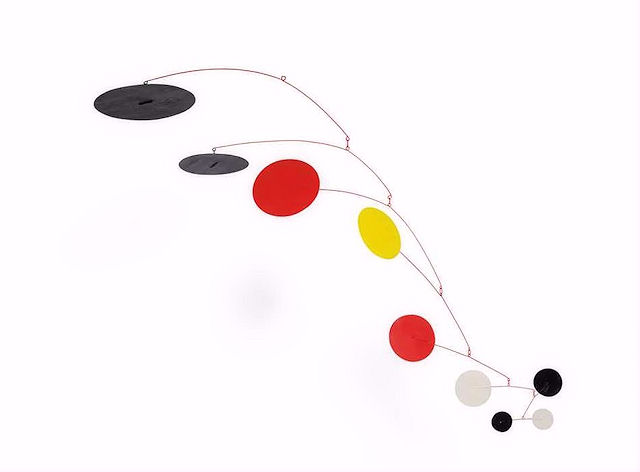
Christie’s Post War and Contemporary Art Evening Auction on October 11th 2012 in London will include Alexander Calder‘s “Hello Allentown“, a hanging mobile he made the same year he passed away, 1976.
Expected to go for US$ 2 to 3 Million. More affordable options are here and here.
Before moving on to the Lot Notes, does anyone know if this quote is really by Calder: “The perpetually changing relations within the mobile gives them a metaphysical identity that relies on temporal memory to assemble the sequence of partial definitions comprising the more complex identity of the whole.”
Lot Notes: ‘The simplest forms in the universe are the sphere and the circle, I represent them by discs and then I vary them. My whole theory about art is the disparity that exists between form, masses and movement’ (A. Calder, quoted in K. Kuh, The Artist’s Voice: Talks with Seventeen Artists, New York, 1962).
Suspended from a sequence of bright red wires, the progression of multi-coloured discs that glides through the air is a triumphal example of Alexander Calder’s iconic mobile sculptures. Having once formed part of the historic collection of Philip and Muriel Berman and in fact titled after their hometown, Allentown, Pennsylvania, Hello Allentown is a tribute to the lifelong journey of collecting during which they amassed an impressive collection of monumental and important sculpture, paintings, drawings and prints. True civic leaders well known for their philanthropy as well as their commitment to championing the work of both young aspiring artists and the masters of their time, Philip and Muriel Berman collection was a testament to their personal connection with the art and in many instances their personal friendships with the artists, a friendship evident through the very title of Hello Allentown. With the artist signature aplomb, the vibrant spheres occupy both the vertical and horizontal planes, commanding the space in which they hang. The black discs that mark the highest and lowest point of Calder constellation act to contain the energetic eruptions of fiery reds and iridescent yellow that are contained within the centre of the configuration. Hello Allentown incorporates two of Calder favourite monikers – his exuberant use of colour and his formal examination of the spherical form. Through these two devices Calder investigates the formal relationship between two of the most basics tenets of art – form and colour – and how they interact, particularly in three-dimensional form. From the large black disc at the apex of the composition the eye is drawn down through a series of graceful arching limbs, each of which supports a round disc which decreases in size as the sculpture draws to a triumphal conclusion, ‘The simplest forms in the universe are the sphere and the circle Calder once said, ‘I represent them by discs and then I vary them. My whole theory about art is the disparity that exists between form, masses and movement’ (A. Calder, quoted in K. Kuh, The Artist’s Voice: Talks with Seventeen Artists, New York, 1962).
In addition to its elegantly balanced form, Hello Allentown is also distinguished by its chromatic range and intensity. Colour was an important expressive device for the artist and one of the most important factors in his compositions. For Calder, colour was not a representational force but rather an emotional one, in much the same way as Henri Matisse and André Derain, the historical pioneers in non-traditional use of colour. As Calder himself once commented: ”I want things to be differentiated. Black and white are first – then red is next. I often wish that I had been a Fauve in 1905” (A. Calder, quoted in Calder, London 2004, p. 89). Hello Allentown clearly demonstrates this philosophy with its harmonious use of black and white discs to compliment the chromatic brilliance of its red and yellow core.
Whilst Calder”s influential visit to Mondrian”s Parisian studio in 1930 is well documented as being the spark that ignited his interest in introducing colour and movement into sculpture, it is perhaps his friendship with Joan Miró that had the greatest influence on his career. The two men first met in 1928 and remained lifelong friends until Calder death in 1976. ”We became very good friends,” Calder once said, ”and attended may things together I came to love his painting, his colour, his personages” (A. Calder, quoted in E. Hutton and O. Wick (eds.), Calder, Miró, London 2004, p. 27). Their friendship was based on outsiders from the established art scene and reveled in their disdain of convention. From the early stages of their relationship, the pair explored the increasingly dominant field of abstraction – Calder prompted by his visit to Piet Mondrian”s atelier and Miró with his painterly forms that would eventually morph themselves into his iconic Constellations a few years later. The various coloured discs of Hello Allentown recall the lyrical, semi-abstracted forms of Miró paintings, a visual relationship that is emphasised by the fact that they held together by wires which resonate with the elegant sense of calligraphic line of the Spanish artist.
The present work is a rare example of a mobile that was produced during the latter part of Calder”s career. From the mid-1950s onwards Calder became increasingly concerned with making large-scale outdoor sculptures, making over three hundred monumental works that were placed in city plazas, corporate lobbies, airports and museum during the post-war building boom. It was through an incredible act of generosity and through their friendship with Calder that Philip and Muriel Berman, the renown first owners of Hello Allentown, provided the financing for Homage to Jerusalem-Stabile (1977), a work that would prove to be the last monumental sculpture planned by Calder but which he would not live to see installed on the site he chose on Jerusalem”s Holland Square. That Calder would return to his beloved mobiles during the final year of his life is testament to the importance in which he held this forms. As such, Hello Allentown represents the pinnacle of Calder”s approach to the prevailing march towards abstraction. Calder wanted to redefine the nature of art, and of sculpture in particular, by taking it off the wall and the pedestal and breathing movement into its static form. The resulting mobiles were his revolutionary response to these ideas of movement and colour and Hello Allentown is the superb result of Calder”s unfettered imagination and his unmatched technical skill as an engineer that enabled him to produce works that spring into life with the slightest breath of wind.
Photo of large custom mobile for private residence in Long Island
I just received a photo of the large custom hanging mobile I made for a private residence in Long Island, New York, installed.
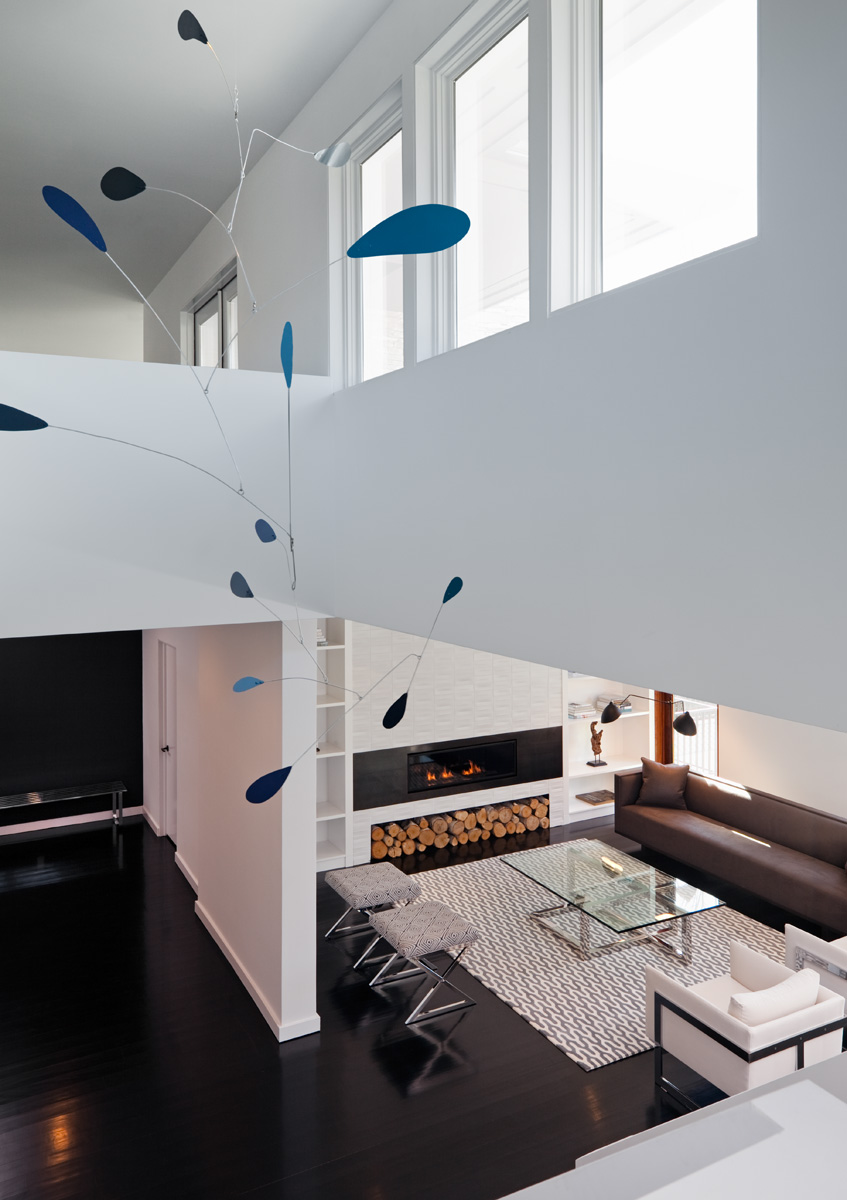
[Click on image for full size]
via Freudenberger Design Studio (formerly Haus Interior)
See more of my large custom mobiles
What Wire to Use to Make a Hanging Mobile and Where to Buy It
I get an email once in a while asking what kind of wire I suggest to use to make a hanging mobile and where to buy it. I just got one again and I figured I’ll just turn it into a post on my blog here.
Most of the time I use galvanized wire for my smaller mobiles which you can get at most hardware stores. It usually comes in a roll (see image below), usually 100 feet long and costs around $6 a roll. Two tips: if you can’t find it in the regular hardware section: sometimes hardware stores have wire in the dropped ceiling section and I’ve also seen wire sold in the household section as clothing line. Any place that has fencing supplies can be a good source too. If you can’t find them in any stores near you, you can get them online at a place like McMaster-Carr.
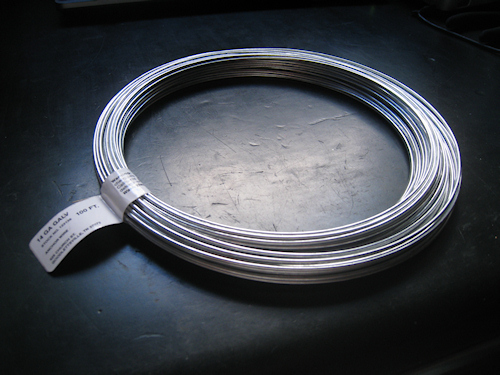
Wire comes in different gauges, the smaller the gauge number the thicker the wire. 18 gauge is very easy to bend and works fine if you’re attaching lightweight things to it like paper shapes. 16 gauge is sort of in the middle, and 14 gauge works good for a little heavier attachments (I use mostly 14 and 16 gauge for my two to three feet sized mobiles where the shapes are made of sheet metal).
If you’re planning on a mobile that’s a little bigger and a little heavier, you will have to get 12 or even 9 gauge wire, but when you go to that thickness it’s becoming increasingly hard to bend. Especially if you start using solid metal rods (rounds), you’ll need to figure out how to bend it in ways other than just with your hands and a pair of pliers. There’s a variety of rod and pipe bending tools that can be applied to certain aspects of making mobiles (if you’re willing to spend the money for one). Di-Acro benders are quality tools in the higher price range (The Art of Bending PDF by Di-Acro can be a useful resource). Or take a look at these instructions on how to make a hook bender, and there are videos on YouTube that show how to make your own rod bending tool.
If you’re planning on making a really large mobile, I recommend you use steel or aluminum rods (rounds) instead of wire, starting with 1/8 inch thick ones. You can get them at a smaller metal retailer such as Metal Supermarkets, or from a large commercial metal supplier like this one. If you’re going even bigger, using solid metal rounds makes the mobile too heavy, especially when using steel. Alexander Calder‘s giant mobile sculpture White Cascade, which measures 100 feet in height, was made with steel and weighs close to 10 tons (!). You want the mobile to move with the air currents. So for a large mobile (33 feet in height) that I made, I used hollow aluminum pipes and aluminum sheet. Despite its size, the mobile ended up weighing only about 100 pounds (45 kg). The 76 foot (23 meters) mobile by Alexander Calder at the National Gallery of Art in Washington, DC, is made with hollow honeycomb-type structures designed by Paul Matisse (grandson of Henri Matisse and son of Pierre Matisse) and covered with paper-thin aluminum, and aluminum and steel bars, with the stress points being strengthened with molybdenum. It weighs 930 pounds (422 kg).
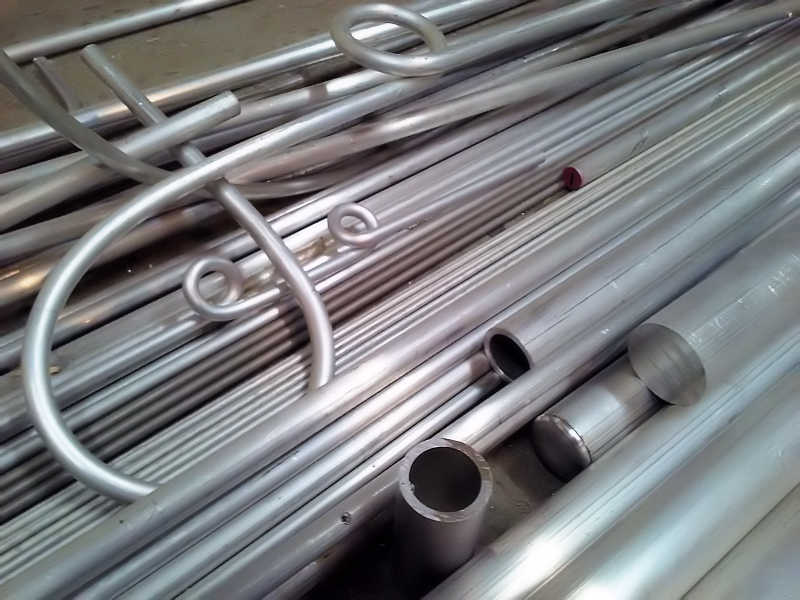
There’s also a table on Wikipedia that shows various data including the gauge, diameter and more of the various wire gauges.
Wire that is already straight (not in a roll) is hard to find. Welding shops sell welding rods (electrodes). They’re straight and usually come in tubes and are usually 36 inches in length, and usually start at a diameter of 1/16″. You can get them in stainless steel or aluminum. Stainless steel is stronger and heavier, aluminum softer and more lightweight. Welding rods come in different alloys. The 1/8″ 4043 aluminum alloy can be bent by hand with pliers, and it’s easy to hammer out flat quickly if needed, but it’s stiff enough to support medium sized elements without flexing. You can also use 1/16″ and 3/32″ of the 4043 aluminum alloy for small mobiles.
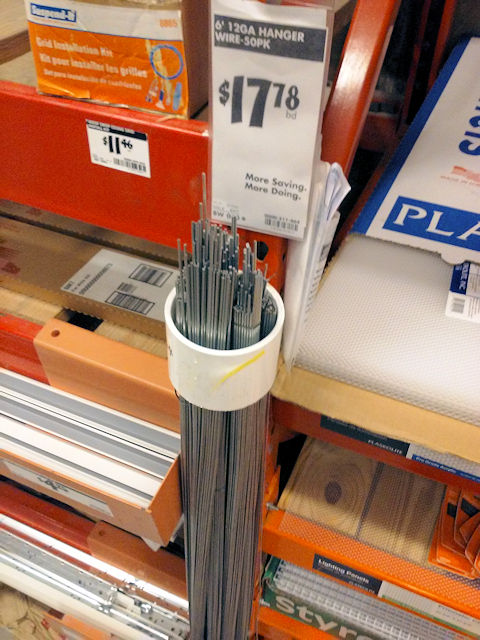
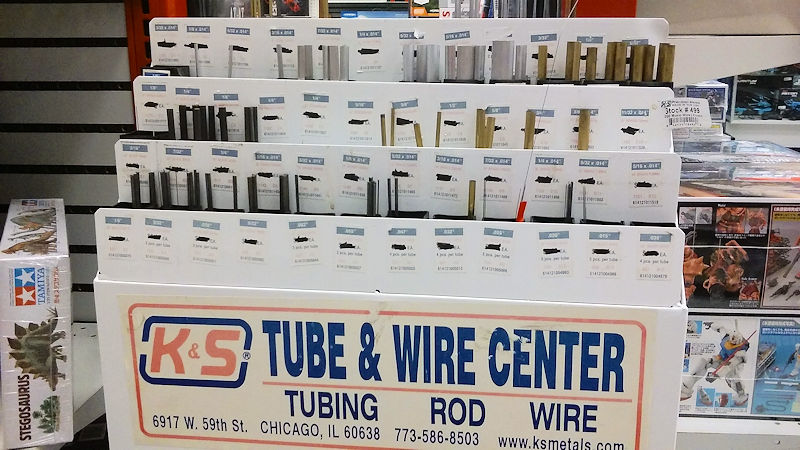
You can find 12 gauge straight wire (not very easy to bend by hand) that’s 6 feet long in the dropped ceiling section at Home Depot. I just checked, I don’t think they sell it online but here’s what it looks like in the store (note it comes in a pack of 50):
You can also straighten wire with the help of a drill and a vice (41 sec video), or with the help of a drill and a wooden block (6:08 min video).
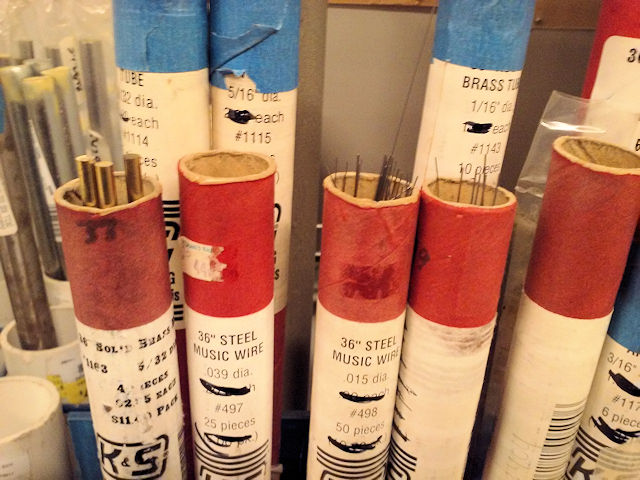
Calder also used piano wire (also known as music wire) from time to time. I found straight round music wire made by K&S Precision Metals at local hardware stores and hobby stores, such as HobbyTown. You can also buy it online directly from K&S Precision Metals. I would maybe try a wire diameter of 0.035″ and 0.047″. For larger mobiles, maybe try a diameter such as 0.055″. As you increase the diameter with music wire, it gets challenging, if not impossible, to bend it with regular pliers. Music wire is stronger, it doesn’t bend as easily. As a trade-off, it allows for thinner wire to be used to make a mobile, which makes for a more sophisticated look, depending on personal preferences.
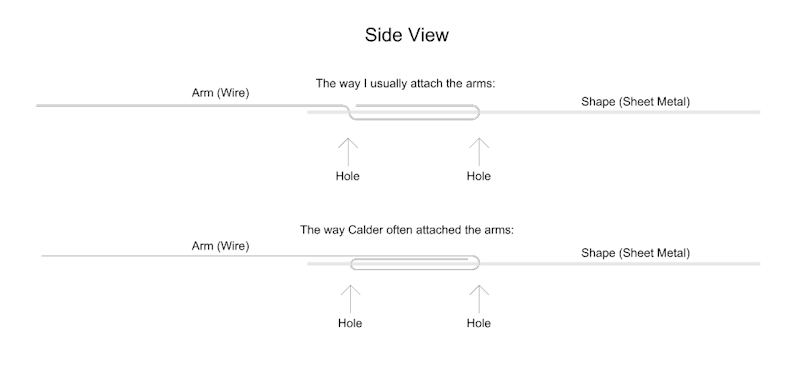
How to attach the wire (arm) to the sheet metal (shape):
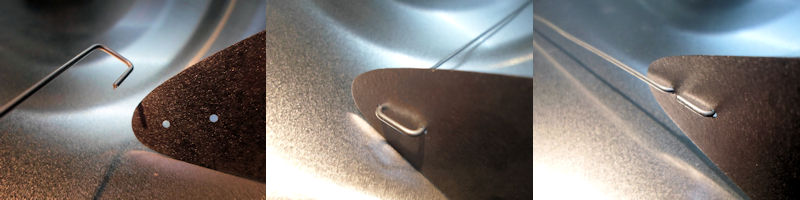
Different methods of looping the wire into the two holes:
A photo of an original Calder mobile illustrating his looping technique (click on the photo for the large resolution image):
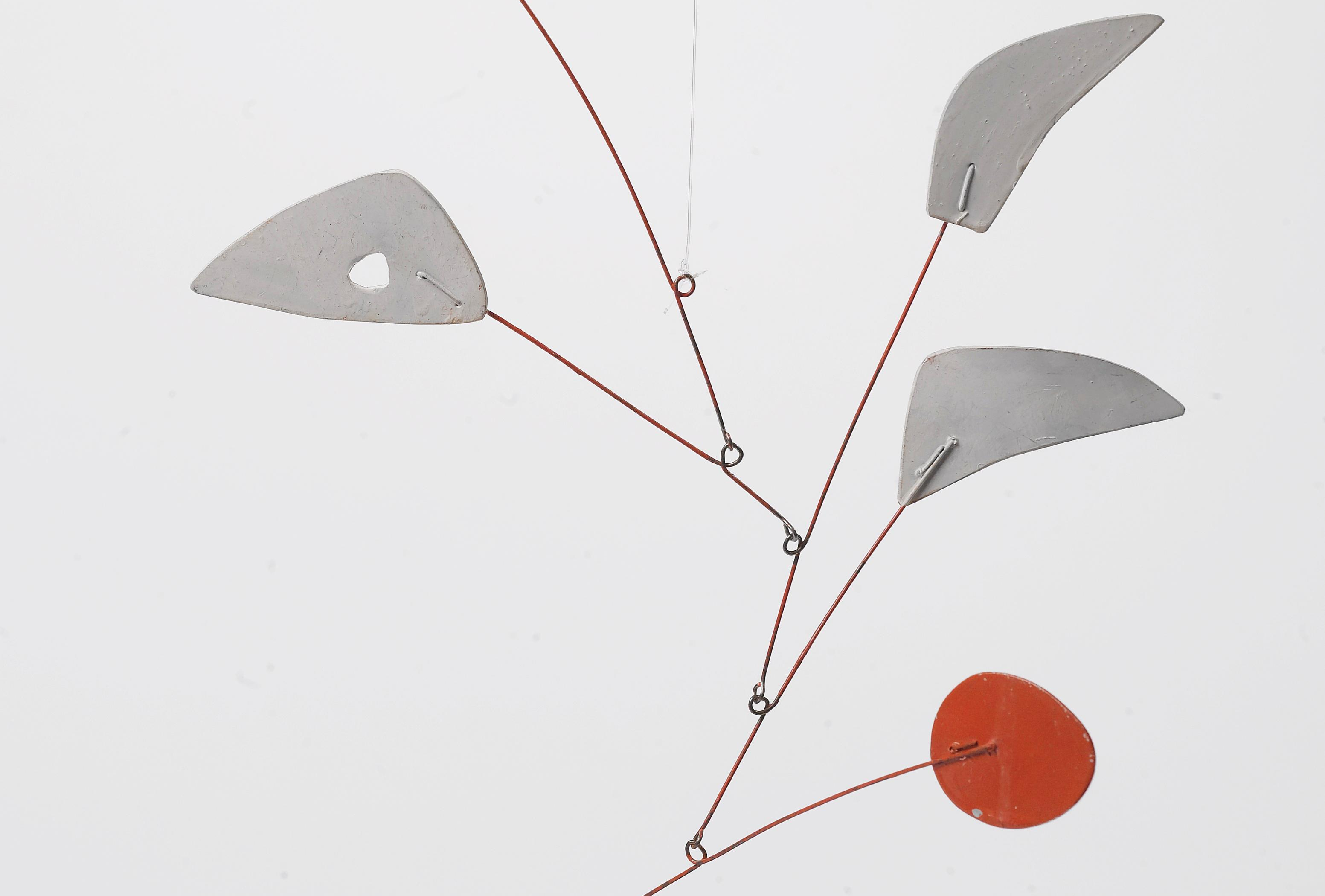
Calder seems to have preferred mechanical ways to attach parts to each other, most often with the help of loops and rivets. Most of his small to mid sized mobiles appear to be made with the two holes and a loop method. He only seems to have used welding on large mobiles and sculptures when really necessary.
In 1962, George Rickey wrote about Calder’s work: “His metalwork can be labored, clumsy and antiquated. Calder seems uninterested in expanding his command of cutting, bending and joining metal, except by farming out the big commissions to professionals – whereupon they lose his touch and the undeniable charm his technical primitivism sometimes imparts. He steadfastly refused to weld or solder or braze his joints; he has preferred to rivet or lace and crimp with wire (like a stapler), or to bolt.”
You can find a more detailed description on how to attach the arms to the shapes in my How-To Make a Mobile article on Houzz.
Additional resources for making mobiles:
- Blog post I wrote explaining some of the basics about the balance of a hanging mobile
- Blog post with mobile-making related questions that I’ve received via email and my answers
- An article I wrote for MAKE magazine on How to Make a Mobile Based on Calder’s Mobiles
- An article I wrote for Houzz: From the Artist: How to Make a Real Mobile – It’s All in the Balancing Points (there’s a number of questions and answers in the comment section of the article as well). The article is now also available in German
- A history of early mobiles that I’ve put together
- Some technical (“behind-the-scenes”) aspects of designing, making and installing a large custom mobile
- A definition of mobiles
- Q&A about Mobiles for a middle school student’s math class project
- See some of my mobiles if you’re looking for design ideas: handmade mobiles, large custom-made mobiles, 3D printed mobiles and kinetic sculptures
If there’s anything else I can help with, don’t hesitate to contact me.
 Included in over 1000 Ideabooks on Houzz
How To Make Mobiles:
- Houzz Article -
- Balance Basics -
- What Wire to Use -
- FAQ Mobile Making -
- MAKE Magazine Article -